

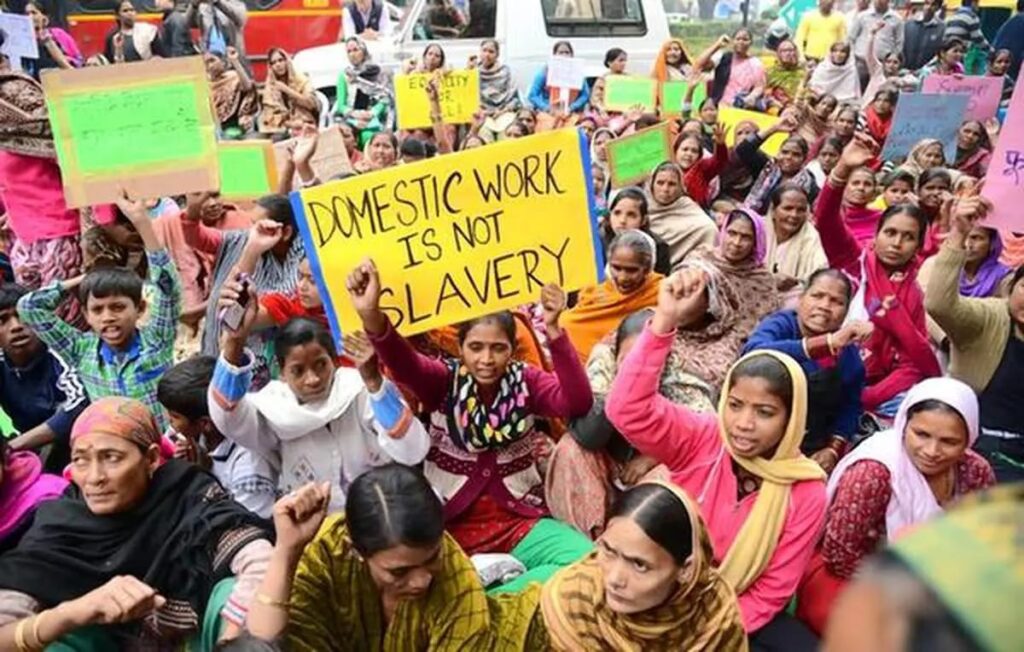
As India seeks to project itself as a modernizing nation committed to dignity and development, one category of labour continues to remain invisible, not because it sits in the margins, but because it takes place behind closed doors. Domestic work, a form of labour that is performed within the four walls of private homes, is still ideologically framed as “help” or “care” rather than labour. This framing is not accidental. It is due to many structural reasons why domestic workers remain outside the moral and legal universe of rights-bearing work.
The argument that “the home is private, and enforceability and regulation are harder” can be frequently invoked to justify the absence of legal protection. But this reasoning does not hold up to scrutiny. Privacy can be treated as a convenient shield behind which violence, exploitation, and unchecked power relations persist, but for how long?. Domestic workers—overwhelmingly women and young girls—are disproportionately from Scheduled Castes, Scheduled Tribes, or economically marginalised communities. This makes it hard for them to navigate this space without contracts, protections, or recourse.
Domestic work is also pushed into the unorganized sector by design. This classification exacerbates harm rather than mitigating it, leaving workers exposed to arbitrary dismissal, wage theft, and routine indignities that would be illegal in any other workplace.
The absence of legal recognition has real consequences. Domestic workers routinely face arbitrary termination in the absence of written contracts; chronic underpayment and unpaid overtime that stretches work well beyond humane hours; and a complete denial of basic entitlements such as weekly days off, sick leave, and maternity leave. Their mobility and dignity are often restricted within the households they serve, as is access to social protection, including insurance, pensions, and compensation for accidents or illness.
The violence domestic workers face is not incidental; it is structural. In a widely reported case, Sujatha (name changed), a domestic helper in Delhi for 28 years, was beaten in public by one of her employers (BBC) — an incident that briefly pierced the walls of domestic privacy to reveal what is otherwise normalized silence.
This is not merely an administrative failure; it could be a political choice. India’s own legislative record supports this conclusion. “The BJP government, since 2014, has presented labour law reform as a top agenda and successfully passed all four Labour Codes by 2020. Still, the government has neither ratified C189 nor are there any discussions regarding it.” (The Leaflet).
The C189 Labour Code refers to the International Labour Organisation’s Convention No. 189, which was adopted to formally recognise domestic work . The central objective of the convention is to establish minimum labour standards and decent working conditions for domestic workers, including fair wages, clear recognition as wage workers, and access to social protection. It serves as a global benchmark for extending fundamental labour rights to a workforce that has historically remained excluded from legal protection.
The refusal becomes harder to justify when the scale of the workforce is considered. According to official statistics, India has 4.75 million domestic workers, including three million women. The International Labour Organization estimates the real number to be between 20 and 80 million. (BBC).
The Supreme Court has also noted that multiple bills — Domestic Workers (Conditions of Employment) Bill, 1959; House Workers (Conditions of Service) Bill, 1989; Housemaids and Domestic Workers (Conditions of Service and Welfare) Bill, 2004; Domestic Workers (Registration, Social Security and Welfare) Bill, 2008; Domestic Workers (Decent Working Conditions) Bill, 2015; Domestic Workers Welfare Bill 2016; Domestic Workers (Regulation of Work and Social Security) Bill, 2017(ssconline Times) — were introduced but never materialised into law.
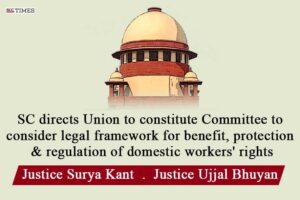
Its is clear that domestic workers remain either excluded or only partially included. The Code on Social Security provides limited and discretionary coverage. The Code on Wages does not guarantee universal application. Inclusion on paper does not translate into enforcement in practice.
Other countries have demonstrated that regulation does not require intrusion into private life. South Africa, in particular, offers a clear rights-based model. The Basic Conditions of Employment Act (BCEA), 1997 – Sectoral Determination 7 (Domestic Workers) mandates written contracts, defined work hours, minimum wages, overtime pay, public holiday wages, paid sick leave, and maternity leave. The Unemployment Insurance Act (2001) and Unemployment Insurance Contributions Act (2002) enable domestic workers to access unemployment, illness, maternity, adoption, and death benefits through a shared contribution model. The COIDA Amendment recognises domestic workers as employees eligible for compensation for occupational injuries or death.These protections did not compromise the privacy of homes. They simply made exploitation legally visible. India’s own courts have repeatedly flagged this legislative vacuum.
Karnataka’s Domestic Workers (Social Security and Welfare) Bill, 2025 proposes a tripartite contribution model where workers, employers, and the state share responsibility. (The Leaflet) Maharashtra enacted the Maharashtra Domestic Workers Welfare Board Act, 2008, establishing district-level welfare boards and enabling domestic workers to voluntarily register for limited social security benefits such as maternity support, education assistance, and medical reimbursements. Kerala followed with the Kerala Domestic Workers (Regulation and Welfare) Bill, 2021, which seeks to recognise and regulate domestic work while improving worker welfare.
Tamil Nadu includes domestic workers under the Tamil Nadu Manual Workers Act, 1982, providing limited access to social security and pensions, but still lacks a comprehensive domestic workers’ law. In 2025, the Madras High Court once again urged the need for special legislation while disposing of a petition filed by a domestic worker from Dindigul district. ( The Times of India)
These fragmented measures only reinforce the central point: the problem is not feasibility. It is political will. As long as domestic work is framed as a private favour rather than public labour, the state can continue to abdicate responsibility while benefiting from the silence that sustains this workforce.
The question, then, is no longer whether India can regulate domestic work. It is whether it chooses to.