

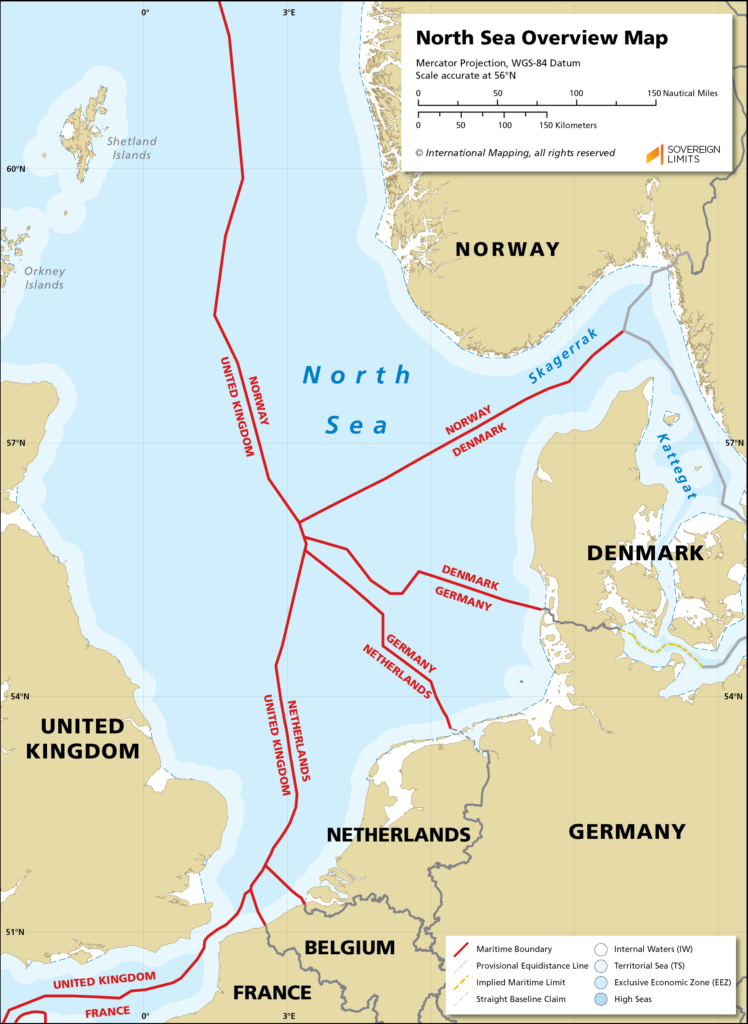
Facts: Apart from having waters 12 nautical miles away from its coasts, a coastal state is separately entitled to take economic resources 200 nautical miles away from its coast. However, controversy surrounded the North Sea because of a continental shelf, which, according to one definition, is the part of the continental margin between the shoreline and the continental slope or, in the absence of a noticeable continental slope, at a depth of 200 m.[1] The North Sea is of extreme significance to countries as it counts among the world’s largest fisheries, oil source, and trade route. Therefore, the case between Federal Republic of Germany and both Denmark and the Netherlands was submitted on 20th February 1967 to the International Court of Justice (ICJ) relating to the delimitation of the continental shelf in the North Sea. Both parties agreed that the delimitation would be conducted based on the judgment being sought from the ICJ. This, as the Netherlands and Denmark insist, should be done in the light of the equidistance principle as under Article 6 of the 1958 Geneva Convention to which the Netherlands and Denmark are a party but the Federal Republic is not. The Netherlands and Denmark responded by saying that, although the treaty may be binding on the states only that signed and ratified it, the 1958 convention is deemed to be part of customary international law and, therefore, should bind all states, including the Federal Republic. However, this interpretation would result in Germany getting a disproportionate portion, which made Germany argue for the apportionment principle of just and equitable allocations of the continental shelf.
Procedural History: The case between the Federal Republic of Germany, Denmark, and the Netherlands was submitted to the International Court of Justice on 20 February 1967.
Memorial was submitted by the Federal Republic of Germany on 21st August 1967. To which, on 20th February 1968, a counter-memorial was submitted by the Government of the Kingdom of the Netherlands. Reply was submitted by the Federal Republic of Germany on 31st May 1968.
In an order of 26th April 1968, the Governments of the Kingdom of Denmark and the Kingdom of the Netherlands were considered parties in the same interest.
A common rejoinder was submitted by the Governments of the Kingdom of Denmark and the Kingdom of the Netherlands on 30th August 1968.
Oral Proceedings of the case took place from 23 October to 11 November 1968 and on 20 February 1969.
The principal argument of the parties in dispute is summarized as follows: Principal Argument of the Kingdom of the Netherlands and Denmark: The boundary is governed by the 1958 Geneva Convention, specifically by the equidistance principle established under Article 6 of the convention. Such principle is deemed the standard generally accepted and rules of international law which govern the delimitation of continental shelf boundaries. In the absence of this being possible, the boundary shall be established on the basis of the respective exclusive rights of each party to the continental shelf adjacent to its coast as well as on the basis that each party retains the continental shelf which is proximate to that party’s coast than to the coast of the other party.
Main Argument of the Federal Republic of Germany: The delimitation of the continental shelf between the parties within the North Sea must be just and equitable among the parties; therefore, there must be a fair and equitable distribution through an assignment of uses and resources within the North Sea. The Continental Shelf Convention is not customary international law.
Rule of Law:
Convention on the Continental Shelf, Geneva, 29th April 1958, art. VI (1, 2, 3).
Article VI (1): Where the same continental shelf is adjacent to the territories of two or more States whose coasts are opposite each other, the boundary of the continental shelf pertaining to such States shall be determined by agreement between them. In the absence of agreement, and unless another boundary line is justified by special circumstances, the boundary is the median line, every point of which is equidistant from the nearest points of the baselines from which the breadth of the territorial sea of each State is measured.
Article VI (2): Where the same continental shelf is adjacent to the territories of two adjacent States, the boundary of the continental shelf shall be determined by agreement between them. In the absence of agreement, and unless another boundary line is justified by special circumstances, the boundary shall be determined by application of the principle of equidistance from the nearest points of the baselines from which the breadth of the territorial sea of each State is measured.
Convention on the Territorial Sea, Art. XII (1, 2), XXIV (1, 2, 3).
Article XII (1): Where the coasts of two States are opposite or adjacent to each other, neither of the two States is entitled, failing agreement between them to the contrary, to extend its territorial sea beyond the median line every point of which is equidistant from the nearest points on the baselines from which the breadth of the territorial seas of each of the two States is measured. The provisions of this paragraph shall not apply, however, where it is necessary by reason of historic title or other special circumstances to delimit the territorial seas of the two States in a way which is at variance with this provision.
Article XX1V (3):Where the coasts of two States are opposite or adjacent to each other, neither of the two States is entitled, failing agreement between them to the contrary, to extend its contiguous zone beyond the median line every point of which is equidistant from the nearest points on the baselines from which the breadth of the territorial seas of the two States is measured.
Issues:
- The equidistance principle is implicitly and explicitly stated in other conventions such as the Fishing and Conservation Convention and Convention on the Territorial Sea. There is no record found of the federal republic opposing the incorporation of equidistance in these conventions. Such as in equidistance principle in Articles 12 or 24 of the Territorial Sea Convention, or in Article 7, paragraph 5, of the Fishing and Conservation Convention.
- The Federal Republic has applied the principle in the delimitation of its continental shelf boundary in the Baltic and its partial continental shelf boundaries in the North Sea, as well as its fishery boundaries under the European
- The equidistance principle has several reasons not to be applicable for Germany such as if Germany did become a party to it, it could have made a reservation under the treaty, and hence if it was open to them to make a reservation under the treaty it is unreasonable to impose a greater obligation under customary international law. Furthermore, the Hague convention was signed by 46 countries and ratified by 39, and this number is not sufficient to hold it as customary law. Since the treaty was signed in 1958 and the dispute commenced in 1967, there was not sufficient time for the treaty to become customary law.
Holdings and Rationale: YES: 11 votes to 6, the court delivered a judgement in the context of the delimitations concerning the problems relating to continental shelf raised by the contentions of the Parties.
Ruling: The court ruled that use of the equidistance method of delimitation was not obligatory as between the Parties. No single method of delimitation was obligatory and delimitation was to be effected by agreement in accordance with equitable principles and relevant circumstances so as to leave as much as possible to each Party all those parts of the continental shelf that constituted a natural prolongation of its land territory, without encroachment on the natural prolongation of the land territory of the other. Furthermore, if delimitation produced overlapping areas, they were to be divided between the parties in agreed proportions or if this was subject to disagreement then equally.
Conclusion: This case is evidence of how non-state actors such as the International Court of Justice can prove as effective in dealing with conflicts between states by evaluating all cases and reaching a conclusion which benefits all parties. It also showcases how maintaining good relations and peacefully resolving conflict over issues like territory can be more effective than other violent means.
[1] Rajput, Sanjeev, and Naresh Kumar Thakur. “Continental Shelf – an Overview | ScienceDirect Topics.” Www.sciencedirect.com, www.sciencedirect.com/topics/earth-and-planetary-sciences/continental-shelf. Accessed 26 Oct. 2024.