

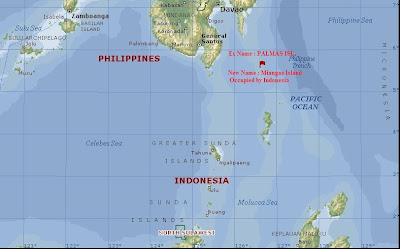
TL; DR:
Spain ceded the Philippines to the USA as part of the Treaty Of Paris (1898). The Island of Palmas (aka Miangas) was within the boundaries of the cession. Later, it was discovered that the Netherlands too claimed the island. The Netherlands had established connections with the people of Miangas and claimed it as their colony. Both parties agreed to refer the case to the Permanent Court of Arbitration, which ruled in favor of the Dutch.
Facts
The United States (Plaintiff) claimed that the Island of Palmas was part of the Philippines that Spain ceded in the Treaty of Paris, but the Netherlands (Defendant) also claimed the title. The United States (P) claimed the Island of Palmas was part of the Philippines and had been ceded by Spain by the Treaty of Paris in 1898. The United States (P), as successor to the rights of Spain over the Philippines, based its claim of title in the first place on discovery. The Netherlands (D) claimed that it had possessed and exercised rights of sovereignty over the island from 1677 or earlier to the present.
Procedural History
The Netherlands and the USA signed a Special Agreement on January 23, 1925, to refer the Island of Palmas (Miangas) dispute to the Permanent Court of Arbitration (PCA) at The Hague, ratified on April 1. On September 9, 1925, the Dutch Ministry of Foreign Affairs and the U.S Minister at The Hague invited Max Huber to arbitrate, which he accepted.
The PCA transmitted the USA and Netherlands memoranda to the arbitrator on October 16 and 23, 1925, followed by their counter-memoranda on April 23 and 24, 1926. Invoking Article III of the agreement, the arbitrator requested further written explanations, received from the Netherlands on March 24, 1927, and the USA on April 22, 1927.
On May 2, 1927, the USA submitted a rejoinder and requested a three-month extension under Article III, granted on May 23 with the Netherlands’ consent. The PCA transmitted the USA’s rejoinder to the arbitrator on October 21, 1927. On March 3, 1928, the arbitrator closed the case in accordance with Article III. On April 4, 1928, three copies of the award were deposited with the PCA’s International Bureau, as required by Article VII.
The Main Argument of the United States of America
was that it was the successor to the territory of the Philippines and Miangas ceded to it by Spain which discovered the island first, thus it was theirs. Furthermore, they argued the principle of contiguity, ie, that Palmas formed a geographical part of the Philippines, which was a contemporary USA colony.
The Main Argument of the Netherlands
was that the Netherlands, represented in the first period of colonisation by the East India Company, possessed and exercised rights of sovereignty from 1677, or probably from a date prior even to 1648, till the time of arbitration. They had entered conventions with the native princes of the Island of Sangi (the main island of the Talautse (Sangi) Isles), establishing the suzerainty of the Netherlands over the territories of these princes, including Palmas (or Miangas) which was under their rule. They also contested the views of the USA, contesting the discovery and acquisition of Spain on the Island and the validity of the principle of contiguity.
Issues:
- Was Spain’s discovery of the island sufficient to establish a title? And if so, whether the title was lost or whether discovery meant that they had the right to give it away.
- Was the principle of contiguity valid?
- Were the conventions entered by the Netherlands with the leaders of the Island of Sangi true?
- Were these conventions applicable to Miangas?
Rule of Law:
General principles of law were applied.
Nemo dat quod non habet:
is a Latin phrase that means “no one can give what they do not have”. It is often used in municipal law, where the purchase of a possession from someone who has no ownership also denies the purchaser any ownership title. In the case of the Island of Miangas, the US could not inherit the island because Spain proved to have no proper title.
Inchoate Titles:
Inchoate means not fully formed. The case held that discovery is an inchoate title, ie, that the title of sovereignty is only valid if the discovering party occupies it within a reasonable amount of time. If the state does not occupy the territory, the inchoate title expires.
Holdings and Rationale:
- Whether Spain discovered the island is irrelevant because discovery did not necessarily mean sovereignty. Spain had not established sovereignty over the island, thus its title of sovereignty that arose from discovery was inchoate.
- No, the principle of contiguity holds no basis in international law.
- Yes, and by contracts of suzerainty, which justifies the Netherlands to claim the Island of Palmas as a vassal state.
- Yes, the arbitrator held that “there can further be no doubt that the Netherlands exercised the State authority over the Sangi States as sovereign in their own right, not under a derived or precarious title.”
Rulings:
The Island of Palmas (or Miangas) forms in its entirety a part of Netherlands territory. The title of contiguity, understood as a basis of territorial sovereignty, has no foundation in international law.
Conclusion:
The case effectively demonstrates conditions of sovereignty and colonialism. It establishes how titles arising from mere discovery are inchoate (incomplete). Furthermore, it also dismissed the principle of contiguity as part of International Law.