

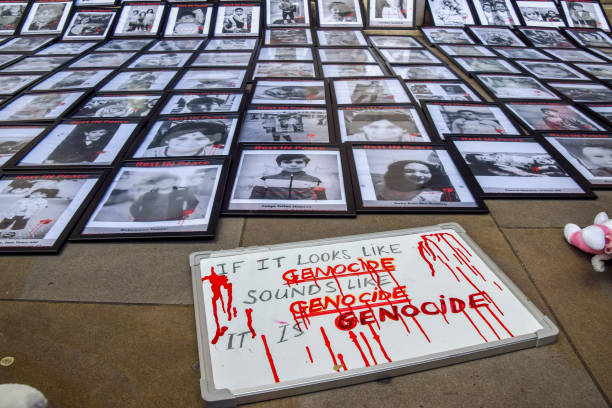
The origins of the word genocide date back to 1944, when Polish lawyer Raphäel Lemkin coined the term and proceeded to campaign for its codification as an international crime. This led to the ‘1948 Convention on the Prevention and Punishment of the Crime of Genocide’ – more commonly known as the Genocide Convention.
Author David Chuter referred to the Genocide Convention as a Nuclear Weapon of Human Rights: like the eagerly anticipated weapon, the Genocide Convention has a symbolic status, being the UN’s first human rights treaty. Yet, like the weapon, it remained dormant and unused in the years following World War II. This has called into question the enforceability of the convention, with major concerns regarding the drafting of the Convention.
Article II of the convention lays down the criteria for any crime to be considered a genocide, as outlined below. Genocide means ‘any of the following acts committed with intent to destroy, in whole or in part, a national, ethnical, racial or religious group, as such:
(a) Killing members of the group;
(b) Causing serious bodily or mental harm to members of the group;
(c) Deliberately inflicting on the group conditions of life calculated to bring about its physical destruction in whole or in part;
(d) Imposing measures intended to prevent births within the group;
(e) Forcibly transferring children of the group to another group.’
Although this definition of genocide was a part of the negotiating process while forming the convention, it has several ambiguities which have inhibited the application and enforcement of the Genocide Convention. One of the biggest contentions with the definition clause is regarding the question of intent. International law includes people from distinct legal systems across the world, each with varying definitions of what constitutes ‘intent’. Given that the type of intent is left unspecified, it remains a contentious topic as to which definition of intent is most apt when it comes to genocide. Till recently, ‘intent’ has been interpreted as *dolus specialis* – a concept which, in the context of genocide, means that the perpetrator would have to clearly demonstrate an intent to destroy a particular group (Ahmed, 2015). While this was seen as the only appropriate definition of intent, the problem lies in obtaining evidence beyond a reasonable doubt. The Holocaust itself, arguably the biggest genocide to have taken place with over 6 million estimated killings, was unable to prove *dolus specialis* due to a lack of a paper trail. Genocides at this scale require a mind capable of an intricate level of planning, manipulation, and organisation; such minds rarely leave behind paper trails which can hold them culpable. Despite substantial oral testimony regarding Hitler’s intent, the lack of an official document indicating the intent to exterminate all Jews means that he cannot officially be held culpable of initiating a genocide. This makes proving intent and, therefore, genocide, a near-impossible task.
Another significant loophole in the definition of genocide is regarding the groups it encompasses through the phrase ‘national, ethnical, racial or religious group’. Firstly, the convention failed to mention political groups. This was done intentionally, in order for the convention to be passed quickly without any further negotiations as well as to protect several nations from future prosecution. The detrimental effects of this limitation are evident, as the mass killings in Rwanda were justified as a killing of the RPF group supporters, rather than as Tutsis – they were hence able to exploit a loophole in the genocide definition and evade any punishment. The definition also fails to include social groups of a general category (such as homosexuals, given that they have a shared identity – the basis of a social group) and forms of cultural genocide (as committed by France and the United Kingdom through cultural destruction in some of their colonies). While it can be argued that crimes against these groups can also be prosecuted as crimes against humanity, it must be noted that crimes against humanity have limited jurisdiction and would therefore not be entirely effective.
Together, these two fundamental issues in the framing of what constitutes a genocide have allowed crimes of mass murder to occur without appropriate repercussions. While the exclusion of certain groups leaves sections of society unprotected, it also gives states a way to evade the label of genocide. The requirement of intent has proven to be an even bigger issue than this, given the strict standards of proof in the international courts.