

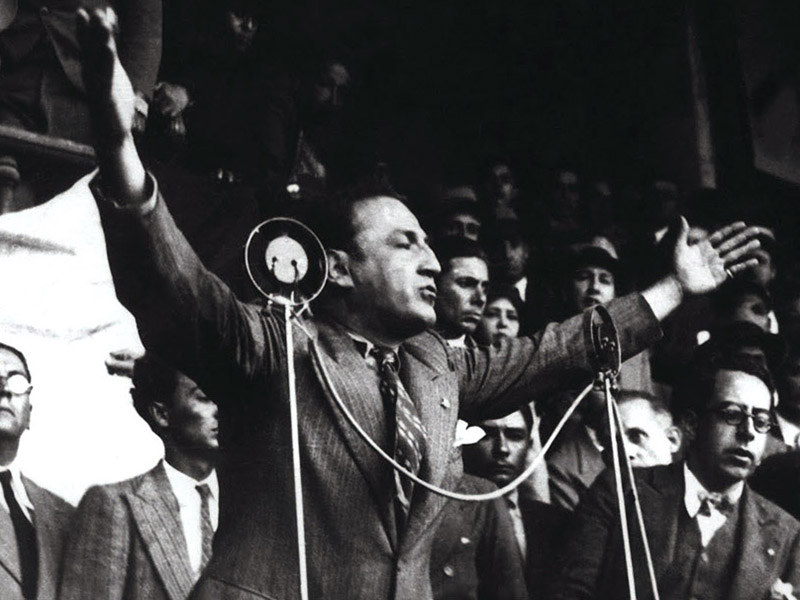
Facts: On October 3rd, 1948, a military rebellion broke out in Peru. However, the rebellion was quelled within a day and the accused were arrested and charged. A day after the rebellion was quashed; proceedings were instituted against Victor Raul Haye De La Torre, a leader of an opposition party known as the American Citizens’ Revolutionary Alliance on the charges of instigating and directing the rebellion. However, on January 4th, 1949, it was brought to the attention of the Peruvian authorities that Victor Raul Haye De La Torre had been granted asylum by the Colombian Mission in Lima and the Colombian ambassador accordingly requested that De La Torre be granted a right of passage or a safe-conduct so that he may leave the country. Peru solemnly refused, stating that De La Torre was accused of common crimes, not entitling him to the protection of political asylum.
Procedural History: On August 31st, 1949, an agreement called the “Act of Lima” was signed at Lima in the name of the Colombian Government and of the Peruvian Government to refer the dispute to the International Court of Justice. The opening of the oral proceedings was fixed for September 26th, 1950. Public sittings were held by the Court on September 26th, 27th, 28th, and 29th and on October 2nd, 3rd, 6th, and 9th, 1950.
The Main argument of the Republic of Colombia: (a) that she is entitled in the case of persons who have claimed asylum in her embassies, legations, warships, military camps, or military aircraft, to qualify the refugees, either as offenders for common crimes or deserters from the army or navy, or as political offenders; (b) that the territorial State, namely, in this case, Peru, is bound to give ‘the guarantees necessary for the departure of the refugee, with due regard to the inviolability of his person, from the country’.
The Main arguments of the Republic of Peru: As a counterclaim, under Article 63 of the Rules of Court and in the same decision, that the grant of asylum by the Colombian Ambassador at Lima to Víctor Raúl Haya de la Torre was made in violation of Article 1 paragraph 1 and of Article 2, paragraph 2, item 1 (inciso primero), of the Convention on Asylum signed in 1928, and that in any case the maintenance of the asylum constitutes at the present time a violation of that treaty.
Rule of Law: (a) the Bolivarian Agreement on Extradition of July 18th, 1911; (b) the Convention on Asylum signed at Havana on February 20th, 1928; (c) Generally, on the rules of international law and custom followed in America.
Issues: a) Under the Bolivarian Extradition Agreement (1911), the Asylum Convention (1928), and American international law, did Colombia, as the asylum-granting country, have the right to determine the nature of the offense for asylum purposes?
b) In this case, was Peru, as the host country, obligated to ensure safe passage for the refugee, respecting the inviolability of his person?
Holdings and Rationale: NO, by 14 votes for, 2 votes against, the court declared that Colombia was not entitled to qualify unilaterally and in a manner binding upon Peru the nature of the offence. NO, by 15 votes for, 1 vote against, it declared that the government of Peru was not bound to deliver a safe-conduct to the refugee. The Court rejected by fifteen votes to one the Peruvian contention that Elaya de la Torre was accused of common crimes; the Court noted that the only count against Haya de la Torre was that of military rebellion and military rebellion was not, in itself, a common crime.
Ruling: The court concluded that Colombia, as the State granting asylum, is not competent to qualify the offence by a unilateral and definitive decision, binding on Peru. In the present case, Peru had not demanded the departure of the refugee and was therefore not bound to deliver a safe-conduct.
Conclusion: Regarding customary regional international law, the Asylum judgment is a leading case. Despite rejecting the presence of a customary Latin-American norm on unilateral qualification of the offense, it is the first precedent of an international court that recognizes the theoretical possibility of the existence of a regional custom. The court made an expansive interpretation of Article 38 of the Statute of the Court, which defines general international custom to encompass special custom. Moreover, the Asylum case also set standards for the recognition of a local custom. The court holds that the party that alleges a regional custom has the burden of proving that it is a duty binding on all parties involved, whereas, in general international customary law, it suffices to prove that most states consented.
REFERENCES:
Asylum (Colombia/Peru). www.icj-cij.org/case/7.
Refworld – UNHCR’s Global Law and Policy Database. “Asylum Case (Colombia V. Peru).” www.refworld.org/jurisprudence/caselaw/icj/1950/en/94532.
Revista Da Defensoria Pública Da União, vol. 19, no. 19, June 2023, pp. 115–40. https://doi.org/10.46901/revistadadpu.i19.p115-140.