

TL; DR:
Equatorial Guinea, formerly a Spanish colony, has long been ruled by authoritarian leaders. The current President’s son, Mr Teodoro Nguema Obiang Mangue, was accused by Transparency International of misappropriating public funds and spending them on luxuries, including expensive cars and a mansion in Paris. Transparency International initiated proceedings under the French “Grinch law” to have the mansion and the cars declared proceeds of crime, seized by the French authorities, and disposed of under French asset-recovery laws.
France asserted jurisdiction because the building stood on French territory, at 42 avenue Foch in Paris. To prevent the seizure, the Government of Equatorial Guinea claimed that the building was part of its diplomatic mission. If the property qualified as embassy premises, it would be inviolable and could not be sold. To reinforce this claim, Equatorial Guinea transferred some diplomatic staff to the building and eventually relocated its embassy there. France objected, pointing out that for years the building had been treated as private property owned by Mr Obiang and that French courts had already found it was purchased with the proceeds of crime. This situation raised a central legal question: Is a sending State’s declaration enough to make a property “embassy premises,” or does the receiving State need to consent? The ICJ held that the receiving State’s consent is required and that such consent may only be withheld if the receiving State fails to act in good faith. The Court explained good faith as follows: “In light of the object and purpose of enabling the development of friendly relations among nations, an objection of a receiving State must be timely, not arbitrary, and not discriminatory in character.”
Since France had clearly and promptly objected, and Equatorial Guinea had not properly notified France that the property was being used as an embassy, the Court found no evidence of bad faith. Accordingly, on 11 December 2020, the ICJ ruled that the building at 42 Avenue Foch had never acquired the status of “premises of the mission” under Article 1(i) of the Vienna Convention on Diplomatic Relations and that France had not breached its obligations under the Convention. On the other hand, there was also a criminal case in France prosecuting Teodoro Nguema Obiang Mangue for money laundering and requiring him to explain his vast wealth, which was suspected to have been acquired illegally through corrupt activities and embezzled state funds. Equatorial Guinea asked the ICJ to order France to stop prosecuting the vice-president, but the court held that Equatorial Guinea had not shown any dispute under the United Nations Convention against Transnational Organized Crime (UNTOC) that could give the court jurisdiction. Therefore, the ICJ stated that it could not order France to halt the criminal proceedings against him.
Facts:
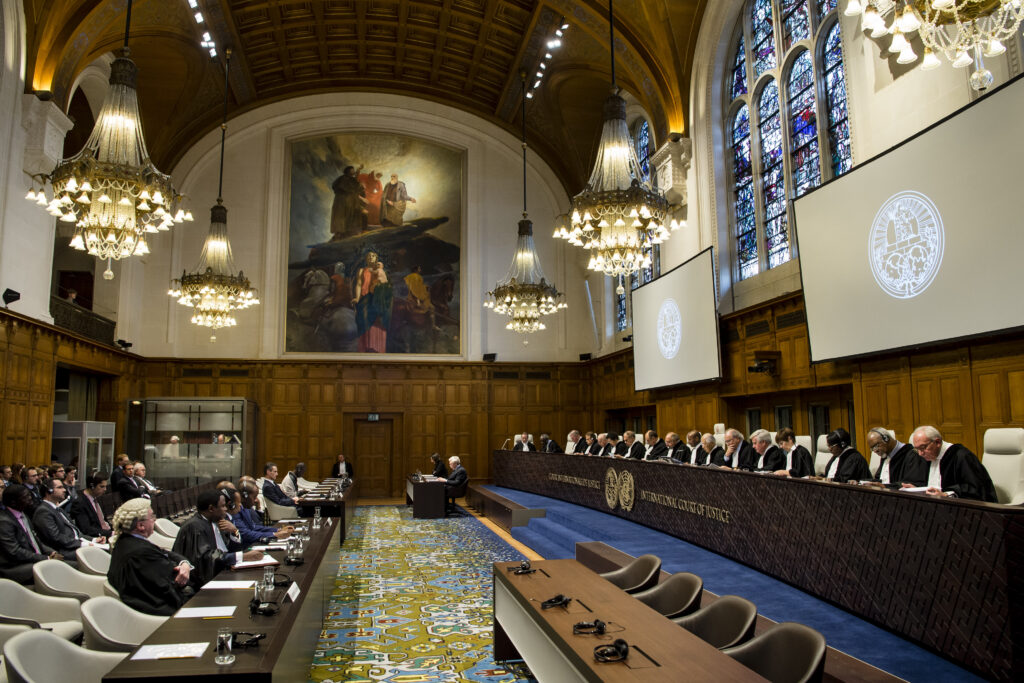
The parties in the case were the Republic of Equatorial Guinea and the French Republic, and the dispute was settled by the International Court of Justice. The matter concerned the property at 42 avenue Foch in Paris, purchased by Teodoro Nguema Obiang Mangue, then Minister of Agriculture and Forestry and later Vice-President of Equatorial Guinea. On 21 May 2012, as part of a government reshuffle undertaken pursuant to an amendment to the Basic Law (Constitution), he was appointed Second Vice-President in charge of Defence and State Security. On 19 July 2012, French authorities placed the building under criminal attachment (saisie pénale immobilière), asserting that it had been acquired using the proceeds of crime as part of an ongoing investigation into corruption and money laundering involving Mr. Obiang. France indicated that the property would be searched and could be permanently seized under French anti-corruption legislation. Equatorial Guinea contested these actions, claiming that the building was being used as premises of its diplomatic mission and was therefore inviolable under the Vienna Convention on Diplomatic Relations. It further argued, on a prima facie basis, that the Court had jurisdiction under the United Nations Convention against Transnational Organized Crime to prevent France from prosecuting Mr Obiang. France denied that the building had diplomatic status, maintaining that proper notification had not been given and that it remained private property. The ICJ held that no relevant dispute existed under UNTOC and therefore no jurisdiction could arise from that treaty. It also found that, under the Optional Protocol to the Vienna Convention on Diplomatic Relations, France had not consented to the designation of the building as embassy premises. Accordingly, the Court concluded that 42 Avenue Foch had never acquired the status of “premises of the mission” and that France had not breached its obligations, making France’s search and investigation lawful. Optional Protocol concerning the Compulsory Settlement of Dispute Vienna Convention on Diplomatic Relations of 18 April 1961 Article 35 of the United Nations Convention against Transnational Organized Crime of 15 November 2000.
Procedural History:
- May 2007 & July 2008 – The associations Sherpa, Survie, and the Fédération des Congolais de la diaspora filed complaints before the Paris Public Prosecutor alleging handling of misappropriated public funds by several African Heads of State and their families, including the President of Equatorial Guinea and his family.
- 12 November 2007—The Paris Public Prosecutor closed the case, finding the alleged offence not sufficiently established.
- 2 December 2008 – Transparency International France and a Gabonese national filed a complaint with a civil-party application before the senior investigating judge of the Paris Tribunal de grande instance concerning similar acts of handling misappropriated public funds against the presidents of Gabon, Congo, and Equatorial Guinea.
- 5 May 2009 – The senior investigating judge held Transparency International France’s civil-party application admissible, dismissing the Gabonese applicant.
- 29 October 2009 – The Paris Cour d’appel overturned the decision, ruling that Transparency International France had not proven material harm.
- 9 November 2010 – The Cour de cassation reversed the appellate ruling and allowed Transparency International France’s civil-party application, recognising the association’s specific mandate and direct interest in corruption-related cases.
- 27 January 2011 – The President of Transparency International France was heard by the investigating judges.
- 1 February 2011 – Transparency International France submitted additional information, identifying assets at 42 Avenue Foch as potentially belonging to Mr Obiang and linked to:
○ Money laundering,
○ Handling misappropriated public funds,
○ Misuse of corporate assets, and
○ Concealment of breach of trust.
- 15 September 2011 – Mr Obiang transferred his shareholder rights in the five Swiss companies to the State of Equatorial Guinea, after which Equatorial Guinea asserted that the building formed part of its diplomatic mission.
- 31 January 2012—The investigation’s “Equatorial Guinean chapter” was extended to include acts of handling or laundering the proceeds of the alleged offences.
- 13 July 2012—French judges issued an arrest warrant against Mr Obiang. The warrant followed summonses he did not attend, citing immunity as a high-ranking State official.
- 19 July 2012 – After a search of 42 Avenue Foch, the French investigating judges ordered the attachment (saisie pénale) of the building, alleging it was financed from the proceeds of the suspected offences and that Mr Obiang had free disposal of it. Mr Obiang appealed this decision.
- 7 February 2014—The Paris Public Prosecutor transferred the case file to the Financial Prosecutor, citing the case’s great complexity.
- 18 March 2014 – Mr Teodoro Nguema Obiang Mangue was examined under an international letter rogatory for alleged acts committed between 1997 and October 2011, including:
○ assisting in hidden investments or converting the proceeds of offences;
○ misuse of corporate assets, misappropriation of public funds, breach of trust,
corruption;
○ acquiring movable and immovable assets using funds from EDUM, SODAGE, and SOMAGUI FORESTAL;
These acts were characterised as laundering the proceeds of the above offences.
- 15 December 2015 – The Cour de cassation rejected Mr Obiang’s claims to immunity and upheld the decision placing him under judicial examination:
○ On personal immunity, the court held that he was not a Head of State, Head of Government, or Minister for Foreign Affairs.
○ On substantive immunity, it found that the alleged offenses were committed for personal gain and before he took up his role as Second Vice-President, during a period when he was Minister of Agriculture and Forestry.
- 23 May 2016 – The Financial Prosecutor issued her final submissions, recommending dismissal or referral of complaints and rejecting Mr Obiang’s claim to personal immunity, concluding he enjoyed no immunity that would bar prosecution.
- 23 May 2016 (same submissions)—The prosecutor stated the building at 42 Avenue Foch was private property, not premises of a diplomatic mission. Applicable legal instruments in the dispute:
○ Vienna Convention on Diplomatic Relations (1961)
○ United Nations Convention against Transnational Organized Crime (2000)
○ General international law on immunities of high-ranking State officials and immunities of State property.
- 23 May 2016 – The final submissions seeking referral of Mr Obiang to the Tribunal correctionnel reiterated that 42 Avenue Foch “does not enjoy any legal protection” because it is not part of the diplomatic mission of Equatorial Guinea.
- 25 May 2016 – As of 25 June 2016, investigating judges were authorised to issue an order referring Mr Obiang to the Paris Tribunal correctionnel for trial.
France’s main arguments:
France’s principal argument was that the Paris mansion at 42 avenue Foch was not recognised as premises of Equatorial Guinea’s diplomatic mission and therefore did not enjoy diplomatic immunity because Equatorial Guinea had not validly established the building as mission premises. France maintained that the property had been acquired with the proceeds of criminal activity linked to Teodoro Nguema Obiang Mangue and was therefore subject to French investigation, attachment and criminal measures. France further argued that Equatorial Guinea’s attempt to treat the building as embassy premises amounted to an abusive attempt to shield alleged criminal proceeds from seizure and prosecution and that French authorities had the right to object to any such unilateral designation. Finally, France asserted that criminal proceedings should proceed against Mr Teodoro Nguema Obiang Mangue for the alleged money laundering and related offences and that any claim to personal immunity did not bar prosecution.
Equatorial Guinea’s main arguments:
Equatorial Guinea argued that France had violated international law by prosecuting Mr. Teodoro Nguema Obiang Mangue and by searching, seizing, and attaching the property located at 42 avenue Foch in Paris, which it claimed formed part of its diplomatic mission. It challenged the legality of the jurisdiction exercised by French authorities, asserting that the building constituted premises of its diplomatic mission and was therefore inviolable. In support of this claim, Equatorial Guinea relied primarily on Article 22 of the Vienna Convention on Diplomatic Relations (VCDR), which guarantees the inviolability of mission premises and prohibits search, seizure, or attachment by the receiving State. Equatorial Guinea further invoked the United Nations Convention against Transnational Organized Crime (Palermo Convention), arguing that the prosecution of its Vice-President and the seizure of the property were incompatible with the Convention’s provisions on State sovereignty and international cooperation. It maintained that the subject-matter of the dispute clearly concerned the interpretation and application of both the VCDR and the Palermo Convention, and rejected France’s contention that its Application was abusive, characterizing it as a legitimate effort to protect its treaty-based rights. Finally, Equatorial Guinea contended that the Court had jurisdiction under Article 35(2) of the Palermo Convention, read together with Articles 4, 6, 11, 12, 14, 15 and 18, as well as under the Optional Protocol to the VCDR.
Rule of Law:
UN Convention against Corruption (UNCAC)
- Article 52 (Prevention and Detection of Proceeds of Crime):
Requires States to apply enhanced scrutiny to high-value transactions involving politically exposed persons (PEPs). France relied on this principle to justify investigating and monitoring assets held by Mr. Teodoro Nguema Obiang Mangue.
- Scope of UNCAC:
Governs domestic criminal enforcement and international cooperation; does not regulate diplomatic immunity or confer ICJ jurisdiction.
Palermo Convention (UN Convention against Transnational Organized Crime)
- Criminal Law Framework:
Concerns criminalization, confiscation, and jurisdiction at the domestic level.
- Article 35 (Dispute Settlement):
Not applicable, as the Convention does not address personal immunities of foreign officials. The ICJ therefore lacked jurisdiction under this treaty.
Vienna Convention on Diplomatic Relations (VCDR)
- Article 22 (Inviolability of Mission Premises):
Applies only to recognized diplomatic premises. France argued the Paris property was not a mission premise.
- Consent of Receiving State:
Designation of embassy premises requires the receiving State’s consent, which France never gave.
- Good Faith Requirement:
France maintained that Equatorial Guinea’s attempted designation was a bad-faith effort to shield private property, allegedly acquired through criminal proceeds, from lawful criminal proceedings.
Vienna Convention on Diplomatic Relations, 1961 (VCDR)
- Article 1 (Diplomatic Functions & Notification): A sending State has discretion to organize its diplomatic mission, including assigning diplomatic functions, after giving due notification to the receiving State, unless the receiving State raises a timely and express objection. Equatorial Guinea relied on this provision to argue that it had validly notified France of the designation of 42 avenue Foch as premises of its diplomatic mission.
- Article 22 (Inviolability of Mission Premises): Diplomatic premises are inviolable and immune from search, seizure, attachment, or execution. Equatorial Guinea invoked this article to claim that France violated international law by searching and attaching the building.
United Nations Convention against Transnational Organized Crime, 2000 (Palermo Convention)
- Article 4 (Protection of Sovereignty): Obligations under the Convention must respect State sovereignty and non-intervention. Equatorial Guinea argued that France’s prosecution interfered with its sovereign functions.
- Article 35 (Settlement of Disputes): Provides ICJ jurisdiction over disputes concerning interpretation or application of the Convention.
Criminal Law Provisions Invoked (Palermo Convention)
- Article 6: Obligation to criminalize money laundering, including concealment and conversion of proceeds of crime.
- Article 11: Duty to ensure effective prosecution and sanctions for serious offences.
- Article 12: Powers of seizure and confiscation of proceeds of crime.
- Article 13: International cooperation for confiscation.
- Article 15: Establishment of jurisdiction over offences with territorial or transnational links.
Core Legal Tension:
The case turns on the conflict between diplomatic inviolability under the VCDR and domestic criminal enforcement obligations under the Palermo Convention.
Holdings and Rationale:
- ICJ’s Jurisdiction under the Vienna Convention on Diplomatic Relations (Holding: YES)
Rationale: The ICJ held that it had jurisdiction under the Optional Protocol to the VCDR concerning the Compulsory Settlement of Disputes. Equatorial Guinea’s claims directly concerned the interpretation and application of Article 22 (inviolability of mission premises), making the dispute appropriate for international adjudication.
- Jurisdiction under the Palermo Convention and UNCAC (Holding: NO)
Rationale: The Court found that neither the Palermo Convention nor the UNCAC confers jurisdiction on the ICJ for disputes relating to criminal proceedings or personal immunities. These conventions regulate domestic criminalization and cooperation, not diplomatic protection, and therefore could not be invoked by Equatorial Guinea to halt French proceedings.
- Status of the Paris Building as Diplomatic Premises (Holding: NO)
Rationale: The ICJ ruled that the building at 42 Avenue Foch did not qualify as “premises of the mission” under Article 1(i) of the VCDR. Diplomatic premises require the consent of the receiving State, which France never gave. Equatorial Guinea could not unilaterally confer diplomatic status on private property.
- Alleged Violation of Mission Inviolability by France (Holding: NO)
Rationale: Since the building was not a protected diplomatic premise, Article 22 protections did not apply. France’s actions in searching and seizing the property were therefore lawful and did not breach its obligations under the VCDR.
- Abuse of Diplomatic Protection Claim (Holding: YES – implicitly recognised)
Rationale: The Court accepted France’s argument that the designation of the building as a diplomatic mission occurred only after criminal proceedings had begun, indicating an attempt to shield assets from seizure rather than a genuine diplomatic function. This undermined Equatorial Guinea’s claim of Inviolability.
Ruling: In Equatorial Guinea v. France, the ICJ (2020) held that the property at 42 Avenue Foch, Paris did not constitute diplomatic mission premises under the Vienna Convention on Diplomatic Relations. Accordingly, France did not violate Article 22 by searching, seizing, or attaching the property. The Court rejected Equatorial Guinea’s claims of diplomatic immunity and protection. The case arose from French criminal investigations begun in 2011–2012 into Teodoro Nguema Obiang Mangue, alleging that the property and assets were acquired using misappropriated public funds. Following the ICJ judgment, French courts in 2021 upheld convictions for money laundering and ordered the confiscation of the Paris mansion and assets worth approximately €150 million, affirming France’s right to proceed with forfeiture.
Conclusion: The Equatorial Guinea v. France case shows that claims of diplomatic immunity cannot be used as a shield to protect assets acquired through criminal conduct. The ICJ clearly held that the Paris mansion did not qualify as diplomatic premises under the Vienna Convention, and therefore France did not violate international law by seizing it. Overall, the case reinforces the rule of law by balancing respect for diplomatic protections with the need to combat corruption, money laundering, and abuse of State power.
Bibliography:
https://www.hrw.org/news/2021/07/28/france-equatorial-guinea-vice-presidents-conviction-
upheld
https://www.icj-cij.org/case/163
https://www.icj-cij.org/sites/default/files/case-related/163/163-20160613-APP-01-00-EN.pdfhttps://www.unodc.org/cld/en/case-law-
doc/corruptioncrimetype/_irb/2018/immunities_and_criminal_proceedings_equatorial_guinea_v.
_france.html
https://cil.nus.edu.sg/immunities-and-criminal-proceedings-equatorial-guinea-v-france-
judgment-of-11-december-2020-by-tutku-bektas/
chrome-
extension://efaidnbmnnnibpcajpcglclefindmkaj/https://legal.un.org/ilc/texts/instruments/english/c
onventions/9_1_1961.pdf
https://www.icj-cij.org/sites/default/files/case-related/163/163-20170330-WRI-01-00-EN.pdf
https://www.icj-cij.org/sites/default/files/case-related/163/163-20170731-WRI-01-00-EN.pdf
https://www.internationalaffairs.org.au/australianoutlook/the-icjs-ju